AB-domination – or why I don’t do sit ups

28 05 2012

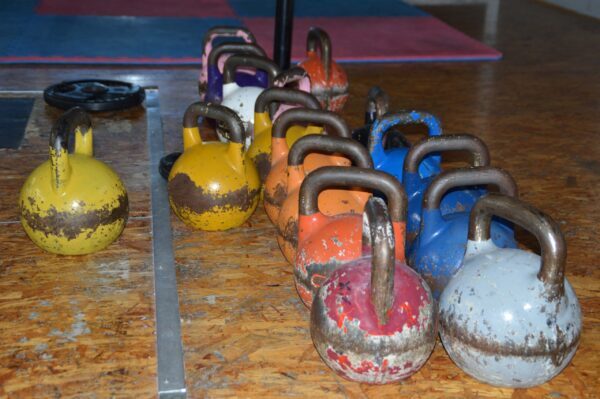
“Dave, why don’t we do more abs in training?” asks Imre between sets of 36kg Kettlebell snatches.
“I’ve not done a sit up or crunch in months and my stomach has never been flatter,” chimes in Linda, a former fitness instructor resting before her next set of front squats.

The Abs question. Again.

Cue picture of six pack:

So, why do I not recommend direct ab work in the vast majority of cases. And how has a former fitness instructor and athlete developed her best physique yet despite dropping all ab work?

It goes like this:

We have limited resources with which to exercise. Most of us work full time, participate in some kind of sport/martial art and many face time consuming commutes to and from work and often to and from training.
With this in mind, we aim to get as much as possible from our training.

A key word I use is efficiency.  Although sometimes I say laziness instead.

I am lazy. I’ve always been lazy, yet I’ve also had high expectations of myself. So, in order to be strong and fit, yet still be lazy, I spent a good bit of time working out what exercises and training styles get the biggest return.

Ab exercises just never made the cut.

But I do recognise the need for strong abs.
I still have “fond” memories of receiving a reverse punch to the solar plexus as a teenager at a karate tournament. I remember how perfectly timed this punch was as I had herded my opponent into the corner, saw an opportunity, went in for the kill only to find my self landing in a heap in the opposite corner of the ring unable to breathe.
It’s moments like these that you start to re-evaluate core strength.

So, in order to be efficient in training, what core / ab exercise do I advocate:

  • Lots of overhead lifting. Especially unilateral overhead work.
    I’m a huge proponent of kettlebell lifting and I believe the one arm clean and jerk is one of the best lifts around. Incidentally this is the lift that has trimmed Linda’s waist and given her a flatter stomach than any amount of standard gym work.
    Overhead work, especially one sided, calls on the entire core unit to stabilise the body.
  • Turkish Get Ups and Windmills
    2 awesome exercise most commonly associated with kettlebells. Both of these lifts rate extremely highly on the core training scale. Not only that but they also promote shoulder stability, balance and general mobility. You can’t lose.
  • Push Ups
    I have too many push up variations to list but each and every one of them is a great ab drill.
    I you go to any “legs, bums and tums” or similar type class I’d guess that at some point you do a plank. The plank is after all one of the great core strength drills, yes?
    Kind of.
    Here at Wild Geese we call the plank by another name, we call it the “rest position”
    But if you hold the body in a plank and then start moving the limbs around, as in a push up for example, now your working. Try then changing the base of support, feet apart/feet together/one foot elevated/one arm elevated…….
  • Pull Ups
    EMG tests have shown the chin up to be an excellent stimulus for the lower abs. This goes up even more if you add a knee raise or L-sit.
    Struggle with pull ups? Try a 90 degree hang, then, just for fun, cycle the legs, like you’re riding a bike really slowly. You’ll never do a sit up again….
  • Front Squats
    Especially kettlebell front squats as the weight is projected further out front challenging the abs even more. I don’t need to go about the other benefits of squats do I? Ok, here’s a quick one:
  • Unilateral swings/snatches.
    What are the core requirements here?
    Anti flexion and anti rotation at the bottom of the swing.
    Anti extension and active rotation at the top of the swing.
    Anti lateral flexion, anti extension at the top of the snatch.
    Pretty comprehensive then.
  • Renegade Rows
    It’s a plank, but it’s done while lifting heavy stuff. There are various styles of this, but for me, go heavy and avoid any rotation of the torso. I guarantee you’ll feel you abs working.
    And your chest.
    And your back.
    And your arms.
    And your legs.
    And your glutes……..
  • Heavy bag work.
  • Sledgehammer slams.
    Want abs? Hit stuff.

Here’s another six pack picture:

 On a related note.

I had a conversation a while ago with a guy and we were talking about why Muay Thai fighters did so many crunches, was it for core strength?
My answer was two fold. Firstly they do them because they’ve always done them. Secondly, they do serve a purpose just not in the way most people think.
Hitting the pads and bags is what develops the strong lean waist of a fighter, hard hitting is one of the great ab developers. The crunches and sit ups, they merely for additional armour plating for when they’re on the receiving end of these strikes.

So there you have it. 9 methods of developing the Abs as well as other areas of the body without doing a single crunch or sit up.

And if you want the abs to show through, spend more time thinking about what goes in your mouth.

Regards

Dave
www.wg-fit.com


Steve Cotter masterclass

26 05 2012

News just in:

Steve Cotter has agreed to run a 3hour masterclass before his CKT seminars.

This will run from 6-9pm on Friday 1st June.
Places are extremely limited, if you do not email or phone to book a place entry will be refused. No walk ins will be accepted.

Cost for this will be a mere €50 per person. Ideally paid in advance, this can be done simplest via paypal (send to dave@wildgeesema.com, specify that this for Steve Cotter as well as your name and contact details.)

If you’re interested, do not hesitate to contact me.


Dave


10 days to Cotter

23 05 2012

We’re now only ten days out from Steve Cotter’s next visit to Wild Geese.

This time it’s serious as it’ll be not just the CKT 1, which we’ve run here before, also the CKT 2 which will be a whole new level.

I am nervous and excited at the same time. I know Steves high expectations, those he sets for himself and which he expects to see reflected in his course participants. His standards are high, he leads by example and he requires all who learn from him to express the same level of commitment.

Each time he’s visited it’s been a new experience. His knowledge and ability to pass on this knowledge has gone up. His patience with questions and his ability to answer them in depth gets better and better (maybe it’s just he understands our accents better…).
His last visit skyrocketed my Kettlebell Sport performance with just a few simple technique tweaks.
It’s his teaching that helped create the training that lead my guys to success in Wexford last weekend (see the last post featuring Phil’s GS sets)

I’m going to link you now to a friends site over in Edinburgh. Rannoch conducted this interview with Steve a while ago and to be fair it’s about the best interview around with the man. Have a look here:

Click here for an interview with Steve Cotter

Click here for an interview with Steve Cotter

See you in 10 days


Dave
www.wg-fit.com


A Physical Demonstration of Mental Fortitude

21 05 2012

I often talk about mental strength on this blog.
It’s a topic that is important to me, after all what use is physical strength without the mind to back it up?
It’s one of the reasons why I enjoy working with the guys over at RehabCare HOPS, the mental health support group/charity. Seeing them progress in the self defence and fitness training I give them is awe inspiring.

But when it comes to the rest of us, what does mental strength look like?
Usually we hear about it in stories and adventures, people doing amazing feats like climbing Anapurna, running the Sahara etc, stuff we can’t really comprehend because it’s so far out of our point of reference.
But if you’re reading this blog then I’d say you’re a little familiar with lifting heavy things over your head. At least I’d hope so.

Over the weekend just passed I was down in Wexford at Mick Kelly’s gym Total Fitness Systems on the Westpoint industrial estate. I was down to support 6 of my athletes all of whom were taking part in the Cup of Ireland Kettlebell lifting competition.
While every lifter did an incredible job and I’m extremely proud of my guys for taking part, I want to show you the two sets performed by Phil Roche.

Why?

Because these clips sum up what mental fortitude is all about. Both videos are around 10 mins long, but if you wish skip to the last 4 mins of each. This is where those 24kg bells really start to feel very heavy.
Phil only weighs 71kg, this is his first competition lifting the 24′s, last year he was using 16kg bells. He’s been training with the 24′s for 14 weeks, prior to that he’d never lifted them.

If you watch the clips see how he wavers and almost quits but then that switch in his head flicks and he digs deeper, drops a gear and just goes for those final few reps. Reps that earned him not only a place on the Irish squad for international competition, but the respect of every person in the room.
Check it out:

1st, the Jerks, 73 of them:

Then the Snatch, all 130 reps:

Well done Phil, and thankyou for demonstrating what mental strength looks like.

Regards

Dave
www.wg-fit.com


Stabilise the Shoulders, Strengthen the Waist and Mobilise the Hip all with this exercise

11 05 2012

The kettlebell windmill.
A very commonly performed drill, and rightly so. when done well it has many benefits not least of which are:

  • shoulder stability
  • core strength
  • hip mobility & strength

So it’s a drill worth learning, and worth learning well.

Set up as follows:

  1. Feet approx shoulder width, maybe wider if needed.
  2. Legs straight, and kept as straight as possible throughout the drill.
  3. Core braced tight.
  4. Shoulders pulled back and down.
  5. Arm on the working side pointing straight up, eyes fixed on this hand.
  6. Other arm acting as a guide following the inside of “unloaded” leg.

Simple eh?

The most common mistakes are not looking up and overbending of the legs.
If you don’t look up it becomes very difficult to keep the chest high and also stabilise the kettle if it is in the top hand. You are essentially putting the back at risk as well as running the risk of loosing control of the bell by simply not looking up.
Over bending the legs is often done as a compensation for a lack of hip mobility. While not too serious in most cases, people with poor glute function end up twisting themselves into all sorts of weird positions, knee valgus (bowing in) is particularly common. Don’t be confused, we don’t need perfect locked out knees, just try to keep them as straight as possible. If this means a reduced range of motion, so be it. Have patience and work on slowly and gradually adding depth.

But how deep should you go?
Thats down to the individual. Go as far as you can safely manage and no further. As you loosen up your range of motion will gradually improve, just have patience.

Here’s a video clip detailing and demonstrating the lift:

Take care with this, learn it slowly and carefully, it will reward patience and persistence.
Most people do well starting with the kettle in the bottom hand before graduating to the top position and finally doubles. Going too hard too soon will cause nothing but pain.

Regards
Dave
www.wg-fit.com


Power Generation for Martial Arts Strikes

10 05 2012

On the eve of Core Combatives founder Mick Coup’s visit to Wild Geese HQ, another world renowned self defence instructor has found himself being banned from entry to the UK.

Tim Larkin of Target Focused Training was due to fly in from LA to present in the UK. Unfortunately it seems the current government over there feel he’s bad influence and will insight violence and vigilantism.
Perhaps the ministers have been watching too many superhero movies. Perhaps they’re genuinely scared of the message Tim carries.
Tim talks openly and bluntly about violence, about causing damage and even of causing death. In short, while he knows his stuff, he is now a victim of his own marketing. You can read more about it here

How long before the less “shocking” amongst us become targeted?
I practice the Filipino Martial Arts predominantly, that means I’m well versed in the use of bladed and impact weapons. Does this mean I should be banned from visiting my old mum in England?

I’d better moderate my commentary. The following video is me talking about the core principle behind my own current martial arts practice. As a lifelong student of martial arts I’ve always tried find the common thread that links the various styles I’ve been exposed to. These days as a father, husband, business owner and coach, I’ve less time than ever to dedicate to martial arts practice. A few years ago I’d spend up to 20 hours per week immersed in the arts, these days I’m lucky to get 20 minutes per day.
So I’ve tried to find the simplest link, the lowest common denominator that runs through all my training.

This clip reveals what that is:

In this next clip I show how the same principle is used with an impact weapon, in this case an eskrima stick, but applicable to anyone who operates in the fields of security and Law Enforcement.

Hope you find these useful and a bit of a break away from the usual fitness info I offer in this site.
I have more martial arts/self defence knowledge to share, so please let me know if you’d like me to continue.

Regards

Dave
www.wg-fit.com
www.wildgeesema.com


More on Cardio and Some Thoughts on Running

4 05 2012

The last post on Cardio seemed to get people talking a bit, which is always cool.
One of the best things about publishing a blog, especially one such as this where I can air all my thoughts and opinions on fitness, is that people come up to me afterwards, or maybe they post a comment, usually on facebook, with a reply.
Sometimes it’s an agreement, other times it’s a thanks or an “I’ll give that a go…” and occasionally it’s “Dave, you’re wrong, stop being an idiot “

Actually that last one usually comes from my wife….

So what was the biggest thing people are saying about the cardio post?

Well for many it’s, “But I HATE running!”
Which is fair enough I suppose, but why do you hate it so much?

We are after all natural runners. As controversial as that sentence may be in today’s gym culture, it must be true. Can you name another mammal that hunts successfully without running? Almost every carnivorous/omnivorous animal has the ability to move with speed, some cover short distances extremely fast, other lope along for hours never seeming to tire.
We humans seem to well adapted to both ends of the spectrum. Some of us are lighting over a short distance, others are quick over longer distances. But we all have the ability to run.

So why don’t you?

For me personally I dislike running in an urban environment, but put me in a park, or better yet out in the mountains and I’m a happy man. I adore being out in the wilds running over rough, uneven terrain, I enjoy the challenge of a long hill climb, especially when you can turn around at the top and admire the view (Dublin looks best when viewed from the top of Three Rock).
For more intense sessions I hit the park, often with the dog and we run short sprints or do some intervals.

Running is one of our primal movement patterns. Don’t believe me?  Try this experiment:

  1. Take a handful of young kids, say for arguments sake between the ages of 5-10years old.
  2. Give them a bit of space, say a park or sports hall.
  3.  Maybe add a ball, possibly a dog.
  4. Stand back and watch.

Pretty soon, with no instruction from anyone, there will be an outbreak of running.

That’s science. Try it.

But if you still refuse to run. Maybe you’re injured and it’s contraindicated, perhaps you’re too out of shape even to run or possibly you’re just being a princess about it. What are your alternatives?

For practical cardio, the type we’re looking to build in our athletes, at least those that aren’t specifically runners/triathletes, the options must allow us to switch intensities or even change exercise at the drop of a hat.
After all when we’re running I often incorporate direction changes or simply drop into a set of push ups, this isn’t so easy when I’m cycling.

Here’s a list of option that we use:

  • Skipping – easy to change speed, convenient to drop and switch to a calisthenic drill and back again.
  • Kettlebell swings – again convenient for switching drills, intensity can be changed by swinging higher/lower, swinging faster or changing the weight.
  • Bag Work / Shadow Drills – Again, easy to modulate the intensity even if it’s harder to quantify. Intensity can be adjusted by hitting harder/softer/faster/slower. Gloves can limit other options if they need to be removed and replaced for other drills.
  • Battling Ropes – these are awesome and they work great for anyone with lower body injuries, are badly out of shape or have limited ROM. Again, easy to modulate intensity by lengthening/shortening the rope and size of wave.
  • Sled dragging – Like the ropes this is very low impact so can be a great boon to those recovering from injury or starting from very poor fitness. Adjust the weight of the sled or speed of the drag appropriately.
  • Weighted Carries – these can be farmers walks, bear hug carry, shoulder carry, waiters walk, whatever variation you like, even be constantly changing the style.

So there you have it. An argument in favour of running and 6 alternatives for those of you who can’t/won’t run.

Regards

Dave
www.wg-fit.com 


Follow

Get every new post delivered to your Inbox.

Join 2,637 other followers